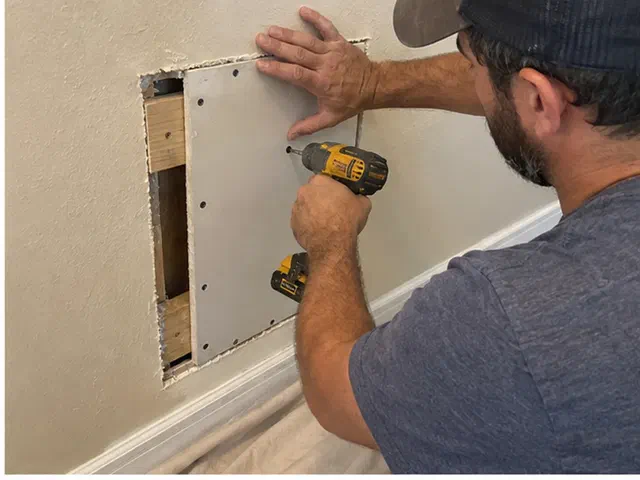
What the Work Involves
We square up damaged drywall to sound material, add backing where the opening has no stud, fasten a new piece, and build the joint out in thin coats. Texture gets matched after the compound dries. We protect the floor, control sanding dust, and tell you whether painting the repaired wall is part of the scope or a separate step.
What You Get
- Solid backing behind the patch
- Joint built out wider so the edge does not show
- Floor protection and dust cleanup
Signs You Need This
- A doorknob punched through the wall
- Old tape is bubbling or peeling
- A plumbing repair left an access hole
- The ceiling stain is dry and the leak has already been fixed
The Leak Has to Be Fixed First
We do not close a wet wall and hope it stays dry. If the damage came from a roof, supply line, drain, or air conditioner, that source has to be repaired and the cavity has to dry before new drywall goes in. Otherwise the stain returns and the patch can soften.
We check the edges of the opening and remove material that has lost strength. If we find active moisture, we stop and show you instead of hiding it behind a new piece.
Matching Orange Peel and Knockdown
Most Central Florida homes have some wall or ceiling texture, and matching it takes more than spraying the patch itself. We feather the texture beyond the joint and adjust the pattern before it sets. Heavy knockdown on a ceiling needs a different approach from light orange peel on a wall.
Paint sheen can still make a good patch flash under side light. When an exact blend matters, painting the full wall from corner to corner usually looks better than touching up a small square.